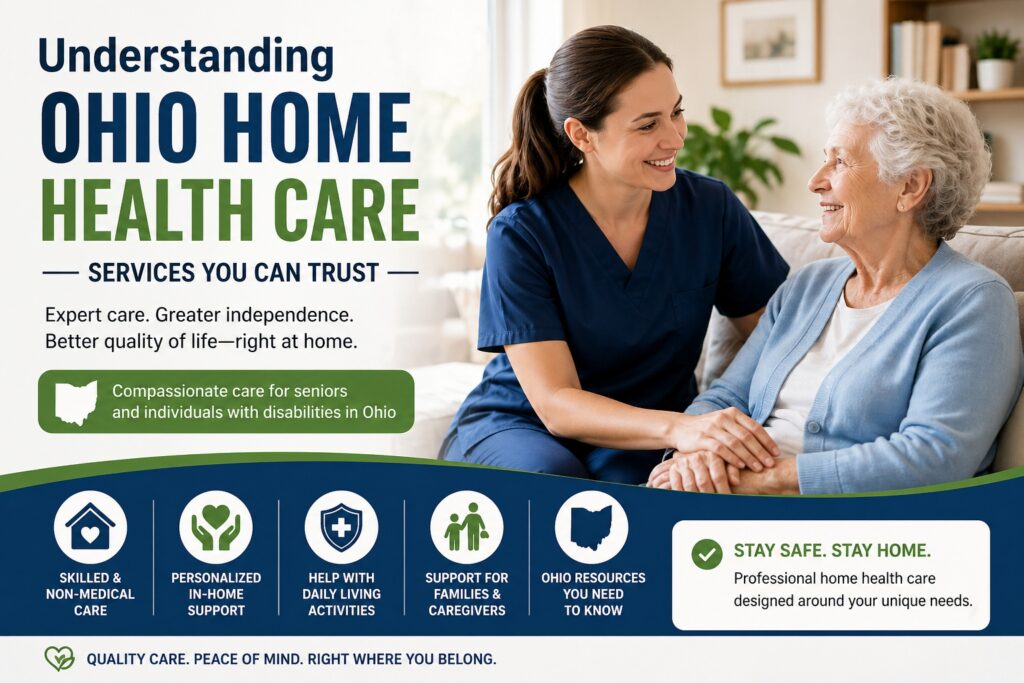
Ohio home health care can include skilled nursing, therapy services, medical monitoring, and in-home support that helps older adults and people with disabilities stay safer and more stable at home. The most important distinction is this: some services are medical and require licensed clinical professionals, while others are non-medical and focus on personal care, daily routines, meal support, companionship, and household help.
For families trying to make sense of the options, the goal is not to memorize every program or acronym. The goal is to understand what kind of care is actually needed, who may qualify, what insurance or Medicaid may cover, and how to choose a provider that can deliver dependable support at home.
What to Know First
- Home health care may include skilled nursing, therapy, medical equipment support, and structured recovery or chronic care services at home.
- Non-medical home care may include bathing assistance, dressing, meal preparation, light housekeeping, medication reminders, companionship, and help with daily routines.
- Eligibility often depends on medical need, physician involvement, insurance rules, functional limitations, and program-specific requirements.
- Coverage is not unlimited. Medicare, Medicaid, waiver programs, and private pay options all work differently.
- The right provider should match the person’s real needs, explain services clearly, and offer a care plan that makes sense for the home situation.
Families usually start searching for Ohio home health care when the current arrangement is no longer working. A parent may be recovering after a hospital stay, managing multiple chronic conditions, or struggling with daily activities that used to feel routine. In other situations, the issue is not strictly medical at all. The person may need help with hygiene, meals, mobility, medication reminders, or simply enough structure and support to remain at home safely.
That is why this topic gets confusing so quickly. The phrase “home health care” is often used loosely, but in practice it can refer to several different layers of care. Some involve licensed clinical services. Others involve non-medical support. Some may be covered by Medicare or Medicaid under certain conditions. Others are arranged privately or through waiver programs. A strong guide has to sort through those differences clearly instead of lumping everything together.
What Ohio Home Health Care Actually Covers
At the broadest level, Ohio home health care refers to services delivered in the home that support health, safety, recovery, and daily functioning. But the category is not one thing. It includes both clinically skilled care and non-medical support, and those are not interchangeable.
Understanding that difference matters because families often start with the wrong assumptions. Some expect Medicare to cover broad daily support indefinitely. Others think “home health” automatically includes help with everything from wound care to housekeeping. In reality, each service category has its own purpose, rules, and limits.
Skilled Home Health Services

Skilled home health services are the clinical side of care delivered at home. These services are usually tied to a medical need and often involve licensed nurses, therapists, or other qualified professionals. Depending on the situation, this may include:
- Skilled nursing visits
- Wound care
- Medication administration or monitoring
- Physical therapy
- Occupational therapy
- Speech-language therapy
- Post-hospital recovery support
- Chronic condition monitoring under a medical plan of care
The key point is that these services exist to address a medical or rehabilitative need. They are not simply general help at home. Families often encounter this kind of care after surgery, illness, hospitalization, injury, or during management of a chronic medical condition that requires professional oversight.
When skilled care works well, it helps bridge the gap between hospital-level treatment and life at home. It allows people to recover or stabilize in familiar surroundings without losing access to trained clinical support. That combination can be especially valuable for older adults who want to avoid longer institutional stays whenever it is safe to do so.
Non-Medical Home Care Services
Non-medical home care serves a different purpose. It supports daily living rather than direct clinical treatment. In Ohio, this kind of care may include help with:
- Bathing and grooming
- Dressing and toileting support
- Meal preparation
- Light housekeeping and homekeeping
- Medication reminders
- Companionship
- Mobility help around the home
- Transportation or escort support, depending on the care arrangement
For many families, this is the category that matters most day to day. A loved one may not need a nurse to visit regularly, but may no longer be managing routine life safely alone. Meals get skipped. Laundry falls behind. Bathing becomes difficult. Medication schedules become inconsistent. The home becomes harder to manage. Non-medical home care steps into that gap and helps preserve independence.
This is also why families should be careful with terminology. Skilled home health and non-medical home care often sit next to each other in the real world, but they are not the same service. One is clinical. The other is supportive. A good article should keep that distinction clear from the start.
Who May Qualify for Home Health Care Services

Eligibility depends on what kind of care is being discussed. There is no single yes-or-no answer that applies to every home care situation, because clinical home health services, waiver-based care, Medicaid-related services, and private non-medical care all work differently.
Who Commonly Qualifies for Skilled Home Health Care
People who qualify for skilled home health services are often those who have a medical need that can be appropriately managed in the home with professional oversight. This may include someone who is homebound or whose ability to leave home is significantly limited, someone recovering after hospitalization, or someone who requires intermittent skilled nursing or therapy under a physician-directed plan.
Older adults with chronic illnesses, mobility limitations, recent injuries, or ongoing rehabilitation needs may also fall into this category. Children or adults with long-term disabilities can qualify as well when the care need meets the relevant medical standard.
The important thing is that eligibility is tied to functional and medical circumstances, not just age. Being older does not automatically qualify someone. Needing specific, medically justified care often does.
How Families Can Determine Eligibility
The most practical way to assess eligibility is to move through a structured set of questions:
- Is there a medical need? If skilled care is being considered, a physician’s assessment usually matters.
- What tasks are difficult or unsafe now? This helps separate clinical needs from non-medical daily support needs.
- What does Medicare, Medicaid, or private insurance actually cover? Coverage rules often define what is realistic.
- Would a waiver program or private home care plan make more sense? Some families need daily help, not intermittent clinical visits.
- Can the home support care safely? Accessibility, layout, and household support all affect what kind of care will work.
Families often get further by thinking in layers instead of looking for one perfect answer. A person may need limited skilled care for a period of time and ongoing non-medical support beyond that. Another may need no clinical care at all, but strong daily support at home. The best path usually becomes clearer once the family stops treating all home care as one category.
Medicare, Medicaid, and Coverage Basics
Coverage is one of the main points of confusion in Ohio home health care. Families often assume that if a need is real, it will automatically be covered. Unfortunately, that is not how these systems work. Benefits depend on medical necessity, service type, eligibility rules, and program-specific limitations.
What Medicaid Home Health Services May Include
Ohio Medicaid can play an important role in making home-based services more accessible, especially for those who meet both care and financial eligibility requirements. Depending on the situation, covered services may include:
- Skilled nursing services in the home
- Therapy services such as physical, occupational, or speech therapy
- Certain medically necessary home equipment
- Personal care assistance with activities of daily living in qualifying situations
For many families, Medicaid-related programs and waivers are the difference between “we cannot manage this” and “we may be able to keep our loved one at home.” That is why it is worth checking eligibility even when the rules seem complicated at first.
Common Exclusions and Limits
Coverage is rarely unlimited. Depending on the program, families may encounter restrictions involving:
- Duration and frequency of services – Services may be limited to certain visit patterns or timeframes.
- Types of care covered – Round-the-clock help, general homemaker tasks, and some non-essential services may not be covered.
- Provider rules – Not every caregiver or agency qualifies under Medicaid rules.
- Equipment and supplies – Only items deemed medically necessary may qualify.
- Geographic access – Some rural areas may have fewer available providers.
- Financial eligibility – Income and asset criteria may determine whether benefits are available at all.
These limits matter because families often build expectations around what home care should include, while the program is built around what it formally authorizes. Closing that gap is one of the hardest parts of planning care.
Why Policy Changes Matter
State and federal policy shifts can directly affect access, provider capacity, and family stability. Payment changes, Medicaid expansion decisions, and reimbursement rules can all shape what services remain available and how easily families can get them. That does not mean families need to become policy experts, but it does mean that coverage should never be treated as fixed or guaranteed forever.
Skilled Care vs. Non-Medical Care: Which One Do You Actually Need?
This is one of the most important questions in the whole topic. Families often start searching under “home health care” when what they really need is everyday help rather than clinical visits. Other times, they assume non-medical support is enough when the person clearly needs skilled medical oversight.
A practical way to sort this out is to ask: what is actually going wrong at home?
- If the issue is wound care, therapy, medical monitoring, or a physician-directed recovery plan, the need leans toward skilled care.
- If the issue is bathing, meals, safety, household management, medication reminders, companionship, or routine support, the need leans toward non-medical care.
- If both are true, the person may need a layered approach rather than a one-track solution.
For many older adults in Ohio, the real answer is that clinical care alone is not enough. A nurse may visit, but someone still has to help with dressing, meals, home safety, and the ordinary tasks that make staying home realistic. That is where non-medical home care becomes central rather than secondary.
How to Choose a Home Health Care Provider in Ohio
Choosing a provider is not just about services on paper. The provider has to fit the person, the home, the schedule, and the family’s ability to coordinate care. That is why agencies that sound similar in marketing can feel very different in real use.
What to Look For
Some of the most important selection factors include:
- Relevant experience with the specific condition or type of support needed
- Clear credentials and training standards
- Good community reputation and credible reviews
- Ability to create an individualized care plan
- Staffing flexibility and backup coverage
- Clear communication with family members
- Transparent cost discussions from the start
Experience matters because not every agency is equally strong in every area. Some are better with post-hospital recovery. Others are better with long-term non-medical support, dementia-related routines, or caregiver consistency. Families should not assume that all agencies are interchangeable.
Questions Families Should Ask
Families make better decisions when they ask direct questions instead of relying on general assurances. Useful questions include:
- What specific services do you provide in the home?
- What training and credentials do your caregivers or clinicians have?
- How do you match caregivers with clients?
- How do you protect safety, privacy, and emergency response readiness?
- Can you provide references or client feedback?
- What happens if the regular caregiver is unavailable?
- What insurance, Medicaid, or waiver arrangements do you work with?
- How are concerns or complaints handled?
- Can the care plan be adjusted if needs change?
These questions are not just administrative. They reveal how the provider actually operates. Families often learn more from how an agency answers than from the answer itself. Clear, grounded responses usually signal a stronger operational reality than vague reassurance.
Workforce and Availability in Ohio
Provider quality is one side of the problem. Availability is the other. Even when a family knows what type of care is needed, staffing realities can affect how quickly support can begin and how stable it remains over time.
Ohio has an active and growing home care sector, but demand for services continues to rise. That affects waiting times, scheduling flexibility, and in some areas the ability to secure consistent caregivers quickly. Workforce trends also matter because they shape family expectations. A strong agency is still working within a larger labor market that may be under pressure.
For families, the practical takeaway is simple: start earlier than you think you need to. If the situation is already becoming unstable, waiting until a full crisis often narrows options. Agencies, waiver programs, and clinical services all work better when planning begins before the household is overwhelmed.
Additional Ohio Resources Families Should Use
Families should not rely only on one agency website or one referral source when evaluating home care options. Ohio has several public and semi-public resources that help verify programs, compare services, and understand coverage better.
Medicare and Medicaid Information Sources
Official Medicare and Medicaid resources help families verify coverage basics, understand service types, and avoid depending entirely on sales language from providers. Even when the rules are frustrating, the official sources are still the baseline for what may actually be available.
Agency and Equipment Resources
Home health agencies, home medical equipment providers, and local support organizations all play different roles. Equipment matters because safe care at home often depends on having the right physical setup: walkers, hospital beds, oxygen equipment, diabetic supplies, and other medically necessary tools can change whether home care works smoothly or not at all.
Support for Family Caregivers
Caregivers need support too. Education, respite guidance, local caregiver groups, and agency guidance can reduce burnout and help families build a care setup they can actually sustain. This is not an optional extra. When caregivers are exhausted and unsupported, care becomes harder to maintain safely.
How Families Can Build a Realistic Care Plan
The strongest care plans are not built around wishful thinking. They are built around the actual needs, risks, and capacities in the home. A realistic plan usually includes several parts at once:
- Medical needs – What requires skilled oversight, therapy, or nursing support?
- Daily living needs – What help is needed with bathing, dressing, meals, mobility, and household tasks?
- Coverage reality – What may be paid for, what may require a waiver, and what may require private pay?
- Family capacity – What can relatives do consistently without burning out?
- Home safety – Are modifications, equipment, or layout changes needed for care to work?
When families answer those questions honestly, they usually make better decisions faster. The goal is not to create a perfect theoretical system. The goal is to build a support structure that the person can live with and the family can maintain over time.
Bottom Line for Families Choosing Ohio Home Health Care
Ohio home health care is not one single service. It is a mix of skilled clinical care, non-medical in-home support, coverage rules, and provider decisions that must all be matched to the person’s real situation. Families do best when they start by separating medical needs from daily support needs and then build a plan that reflects both.
If the need is clinical, focus on medical necessity, eligibility, and provider quality. If the need is daily support at home, focus on non-medical home care, safety, routine help, and caregiver fit. If both are true, use a layered plan instead of expecting one service category to do everything.
The right combination of services can make the home safer, reduce stress for the family, and help a loved one remain more independent than they could without support. That is the real value of understanding Ohio home health care clearly instead of navigating it through guesswork.
Disclaimer: This content is for informational purposes only and does not substitute professional medical, legal, or insurance advice. Coverage, eligibility, and program details can change. Families should verify decisions with qualified professionals and the relevant agency or payer.
Selected Resources
- Medicare Care Compare – Home Health
- CMS – Home Health Payment Rule Fact Sheet
- Health Policy Ohio – Medicaid Expansion Study
- America’s Health Rankings – Ohio Home Health Care Data
FAQs
1. What is the difference between home health care and non-medical home care in Ohio?
Home health care usually refers to skilled medical or therapy services delivered at home, while non-medical home care focuses on daily support such as bathing, dressing, meal preparation, housekeeping, medication reminders, and companionship.
2. Who may qualify for skilled home health care services in Ohio?
Eligibility often depends on medical need, physician involvement, functional limitations, and program rules. People recovering after hospitalization, managing chronic illness, or needing intermittent skilled nursing or therapy at home may qualify.
3. Does Medicaid cover home health services in Ohio?
Ohio Medicaid may cover certain skilled services, therapy, medically necessary equipment, and some personal care support, but coverage depends on eligibility, service type, and program-specific limits.
4. What should families ask before choosing a home health care provider?
Families should ask about services offered, caregiver or clinician qualifications, emergency procedures, backup staffing, insurance or Medicaid participation, care plan flexibility, and how the agency handles concerns or complaints.
5. How do I know whether my loved one needs skilled care or non-medical help at home?
If the main issue is medical monitoring, therapy, or nursing needs, skilled care may be appropriate. If the main issue is bathing, meals, daily routines, safety, or household support, non-medical home care may be the better fit. Some families need both.
